
SecondEcho: A New Way to Save and Share Your Memories
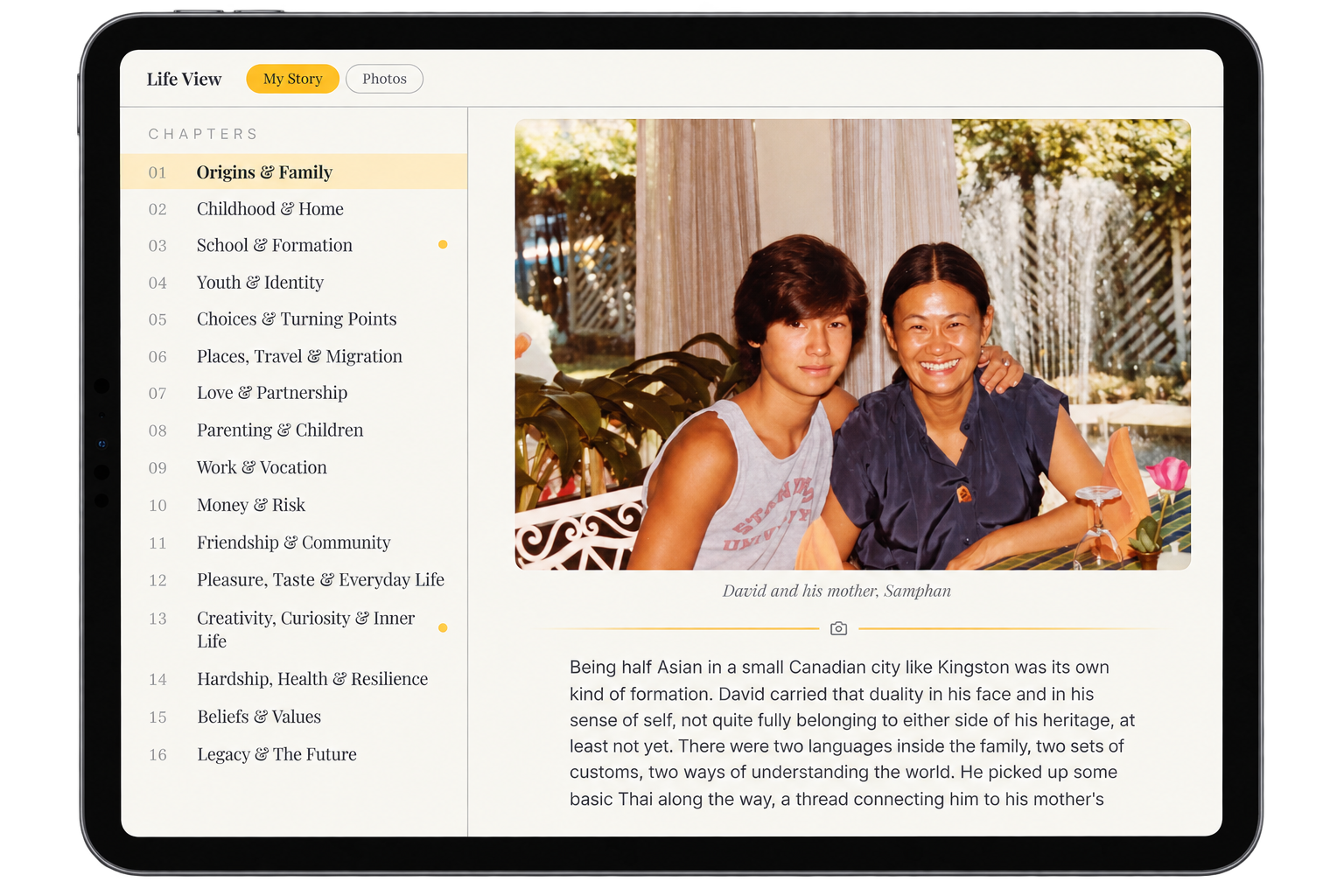
SecondEcho is a new way to save and share your memories. Using AI, it helps turn your stories, photos and experiences into a searchable Memory Archive, your life story, and a beautiful full-color premium book.
Why I Created SecondEcho
SecondEcho started with my mom.
For years, I watched Alzheimer’s slowly take away her memories, the stories, details and moments that made up her life. It made me realize how fragile memory is, and how little we actually preserve.
We have thousands of photos, old messages, notebooks and files, but most of it is disconnected and missing the story behind it.
That became the idea behind SecondEcho.
I wanted to build a better way to save and share our memories while we still can. A place where you can simply talk, write or add photos, and gradually build a searchable Memory Archive and the story of your life..
Over time, those memories can also become a beautiful full-color premium book that can be shared with your family and passed on.
SecondEcho isn’t about replacing memory with AI. It’s about using AI as a tool to help us hold on to the stories that matter.
Frequently Asked Questions
-
SecondEcho is a new way to save and share your memories. It helps you capture stories, photos and experiences through voice or text, then uses AI to organize them into a growing Memory Archive and life story.
-
SecondEcho was created by David Usher, Jonathan Gallivan and the team at Reimagine AI. The idea grew out of David’s experience watching his mother’s memories disappear because of Alzheimer’s and realizing how poorly most of us preserve the stories of our lives.
-
David created SecondEcho after watching his mother lose her memories to Alzheimer’s. It made him think deeply about how fragile memory is and how easily family stories disappear if we do not capture them while we can.
-
You can simply talk, write or add photographs as memories come to you. SecondEcho helps organize those fragments into people, places, moments, chapters and stories, creating a searchable personal Memory Archive over time.
-
Yes. Your memories and stories can be turned into a beautiful full-color premium book that you can keep, share with your family and pass from one generation to the next.
-
A Memory Archive is a growing collection of your stories, photographs, people, places and experiences, organized so they can be searched, explored and shared later.
Instead of leaving memories scattered across phones, photo libraries, notebooks and old files, SecondEcho brings them together with the context that gives them meaning.
-
Yes. SecondEcho is designed to help you preserve your own life story gradually rather than requiring you to sit down and write an autobiography from beginning to end.
You can start anywhere, childhood, yesterday, a photograph, a person or a moment, and build your story over time.
-
Yes. SecondEcho can also be used to help capture the memories and stories of parents, grandparents and other people who matter to you.
The most important thing is to start asking questions and recording those stories while they can still be told.
-
SecondEcho can help you create a memoir or life story, but it is designed to be more flexible than a traditional autobiography.
Memory is not chronological. SecondEcho lets you capture memories whenever they surface and helps organize those fragments into a more coherent story over time.
-
Yes. Photographs can be added alongside spoken and written memories.
The goal is not simply to store the photograph, but to preserve the story behind it: who was there, where it happened, what was going on in your life and why that moment mattered.
-
SecondEcho is not primarily an Alzheimer’s product.
It is designed for people who want to preserve their own memories and life stories, or help preserve the stories of people they love. David’s experience with his mother’s Alzheimer’s was the inspiration for creating a better way to save those memories before they disappear.
-
Yes. SecondEcho uses AI to help organize memories, connect related stories and turn fragments of a life into a more coherent archive.
The AI is there to help with the process. You remain in control of your story and can edit or change what is created.
-
Yes. You can leave the story largely as SecondEcho organizes it, make small corrections or rewrite sections completely.
It is your story, and you decide how much or how little you want to change.
-
Photos preserve what something looked like. They often do not preserve what actually happened.
SecondEcho is designed to capture the context around those photographs, the people, relationships, places, stories and details that explain why a moment mattered.
-
A journal usually requires you to sit down and write consistently. SecondEcho is designed around the way memory actually works.
You can speak, write or add photographs whenever something comes back to you, then let those individual memories gradually become part of a larger life story.
-
SecondEcho uses AI to help you capture, organize and connect your memories. As you talk, write and add photos, AI helps turn those fragments into a searchable Memory Archive, organize them into chapters and build the story of your life. The AI is there to help you remember, organize and create, while keeping your experiences and your voice at the center.
-
You retain ownership of the memories, stories, photos and other personal content you add to SecondEcho. Your Memory Archive and life story are yours. SecondEcho uses AI as a tool to help you organize and preserve your memories, not to take ownership of them. You decide what you create, edit and share.
-
You can learn more and start preserving your memories at SecondEcho.ai.